Winter Getaways
Sun & Sea: A Winter Escape to the Mediterranean Coast
Luxury car rental across five of the Mediterranean's most sought-after coastal cities, built for winter and spring
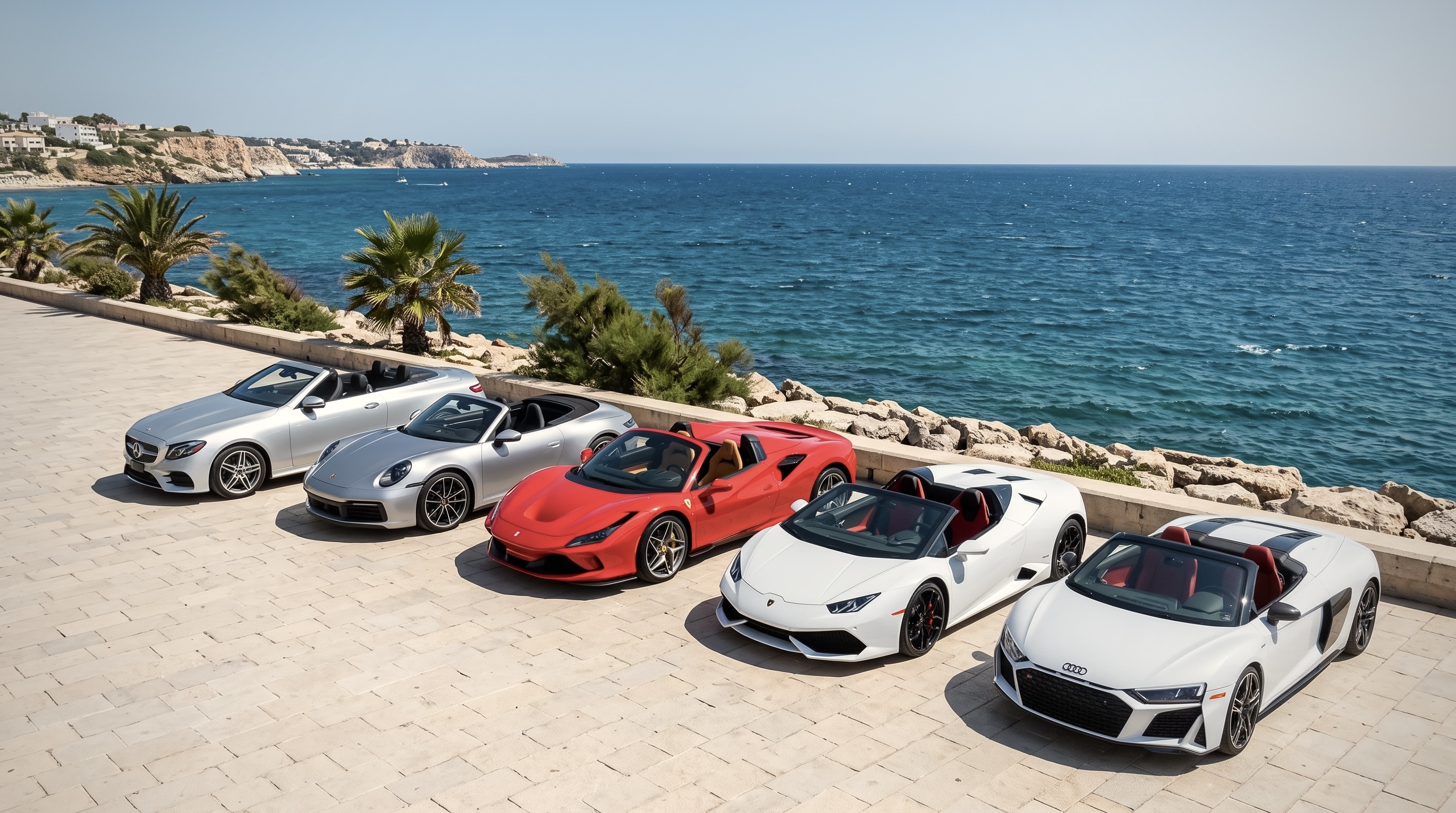
Zeus Prestige offers luxury car rental in five of the most sought-after Mediterranean coastal cities for a sun-drenched winter or spring getaway: a Porsche 911 Carrera S Cabriolet in Málaga, a Lamborghini Huracán Spyder in Barcelona, an Audi R8 Spyder in Alicante, a Mercedes E-Class Cabriolet in Lisbon, and a Ferrari F8 Spider in Naples.
The palms get you first. They lean in over the Paseo del Parque tall enough to close a canopy above the road, and with the roof down on the Porsche 911 Carrera S Cabriolet, you feel the temperature drop a few degrees every time you pass under one, then climb back into the sun on the other side. Somewhere up in that canopy, the monk parakeets are already making themselves known, a bright, chattering racket that Málaga has stopped noticing and every first-time visitor can't stop noticing. Under it all, the flat six holds a low, even hum, patient at low speed, ready to open up the second the road does.
Follow the water east and the city thins out into fishing neighborhoods where lunch still means the same thing it's meant for a hundred years: espetos, sardines threaded onto a cane skewer and propped over a fishing boat's own fire, right there on the sand. You smell the chiringuito before you see it, olive wood smoke drifting out over the promenade, sharper and sweeter than any grill smoke has a right to be.
Take the car up to Gibralfaro after, the 10th-century fortress on the hill above the city, and the road climbs just enough to change what's on the horizon. On a clear winter day, past the strait and past the haze that swallows it whole every summer, the mountains of Africa sit low and blue along the edge of the sea. A glass of Dom Pérignon catching the light tastes better with the view up there.
Come the holidays, Calle Larios turns into one of the more talked-about light displays in Europe, several million bulbs strung block after block in a show set to music, crowds packed shoulder to shoulder murmuring up at it, the Cathedral running its own projected light show most evenings a few streets over. It builds through December and holds until the Cabalgata de Reyes marches through on January 5th. Holiday shopping happens inside a wonderland of lights that pulls the season out of everyone who walks under them, boutiques along Larios staying open late while the crowd drifts from window to window under the glow. Nose the car in after dark and the paint picks up every color in the display at once, the cabin lit by nothing but the dash and whatever's spilling off Larios.
Point the car inland when the mood calls for it, and Granada makes the case for itself. Take the coast road east first, and above Nerja the white houses of Frigiliana appear stacked up the hillside like something poured rather than built, worth slowing for even if you don't stop. Cut north from there and the air through the vents starts doing something the coast never asks of it, noticeably colder against your arm even with the sun still out. The Sierra Nevada holds its snow well into spring, and a terrace table in the Albaicín, up near the Mirador de San Nicolás, gives you the Alhambra head on with those white peaks stacked up behind it, a Moorish palace with a ski range for a backdrop. Lunch there does the job better than any ticket line could.
Evenings pull back toward the coast. The valet takes the keys at the door, that small formal handoff that makes a night feel like it's actually begun, and Málaga's old town keeps going well past midnight for anyone not ready to let it end.
Explore Porsche rentals in Málaga
Alicante's Explanada de España runs along the marina in wave patterns, nearly seven million marble tiles laid in bands of red, black and cream, four rows of date palms shading the tapas stands set up underneath. Take the Audi R8 Spyder along it slow enough to feel the tiles pass under the tires, Castillo de Santa Bárbara watching over the whole scene from its rock outcrop on Mount Benacantil, a fortress with roots in the 9th century and walls mostly rebuilt in the 16th. The climb up is worth the detour, the V10 finally getting to stretch on the switchbacks before the view opens up over the bay at the top.
Alicante's Monumental Nativity Scene in the Town Hall Square holds an actual Guinness World Record, and the angels marking its route are strung out across the city rather than kept in one place, turning the walk between them into its own kind of scavenger hunt. Turrón belongs here more than anywhere else in Spain, the nougat itself invented in the province back in the 15th century, still made a short drive away in Jijona. The Plaza de Toros, a bullring that's never once seen snow, spends December and early January as an ice rink instead, skaters circling where matadors usually stand. On January 5th, the Three Kings arrive by sea at the port before their parade cuts through the city center, a detail no other city on this coast can claim quite the same way.
Head north up the coast first, the Peñón de Ifach rising straight out of the sea long before Calpe itself comes into view, a natural rock nearly 350 meters tall with the town wrapped around its base. Turn inland from there and you'll be rewarded for bringing your jacket. With the top down, a sweet floral scent embraces you before the citrus groves even come into sight, orange trees running in rows toward the hills once you catch up to it. The CV-70 picks up soon after, switchbacks stacking up through pine forest and craggy valleys on the way to Guadalest, a castle carved into a rock pinnacle above its own reservoir. It's the kind of road the R8 was built for, tight enough to keep both hands busy and scenic enough to make you want to slow down anyway.
Evenings belong back on the Explanada, the tiles lit up underfoot, dinner at one of the cafés lining the promenade, and the R8 parked where everyone walking past can't help but look twice.
Explore Audi rentals in Alicante
Passeig de Gràcia, in Barcelona, is the address to take slow. Gaudí's stonework along both sides, Casa Batlló's bone-white balconies on one block and La Pedrera's rippled facade a few doors down, and the Lamborghini Huracán Spyder drawing its own share of looks right back. The V10 doesn't do quiet, and on a boulevard built for looking, that's exactly the point.
Drive past the Sagrada Família and the comparison makes itself. Gaudí broke every rule of what a church was supposed to look like, and 144 years after he started it, the central tower finally topped out this year at 172.5 meters, the tallest church spire in the world, completed in the same year as the centenary of his death. Bold, uncompromising design that took a century to fully arrive tends to age better than anything built to blend in, and the Huracán isn't blending in either.
Fira de Santa Llúcia has run in front of the Cathedral since 1786, the oldest Christmas market in Spain, wooden stalls selling nativity figures and hot torró under strings of lights strung block to block down Passeig de Gràcia. Every second corner has a chestnut vendor turning them over an open drum, shells blackening and splitting, the smoke off them woody and sweet with something earthy underneath, thick enough to catch in your throat before you've even seen the flame. Catalan tradition adds the tió de nadal to the mix, a small log dressed up with a painted face and a blanket, fed scraps through December until children beat it with sticks on Christmas Eve, singing to it until it "delivers" gifts. It's strange in the best way, and worth asking a local to explain in person rather than reading about it here. The season runs through January 5th, when the Cavalcada de Reis parades through the city center to close it out.
Tarragona is under an hour and a half down the coast, the old Roman capital of Tarraco. Let the car climb the Passeig de les Palmeres, the palm-lined promenade that rises to the Balcó del Mediterrani, a cliff-edge lookout named in 1863 for the view it still delivers. Below, the 2nd-century amphitheatre sits carved into the hillside facing the sea, once holding 15,000 for gladiator fights; across the road, the Roman Circus, older still, held 30,000 for chariot races. Two thousand years of stone on either side, and parked at the top, a car that couldn't look less like it belongs to any of it, which is exactly the point of bringing it here.
Sant Sadurní d'Anoia, the heart of Cava country, is closer still, forty-five minutes inland, where the vines begin showing their first leaves in April and the wineries stay open for visits year-round regardless of the calendar. For the drive itself, the back road between Gelida and Martorell is the one locals rate for a reason, switching back on itself through the hills with Montserrat's jagged silhouette showing up over the vineyards every time the road straightens out. It's a detour, not a shortcut, and worth taking in a car built to be driven rather than just arrived in.
Evenings settle back into the city with a glass of Krug on a rooftop somewhere above the Gothic Quarter, the Huracán parked below, streetlight sliding along its paint every time someone walks past for a second look.
Explore Lamborghini rentals in Barcelona
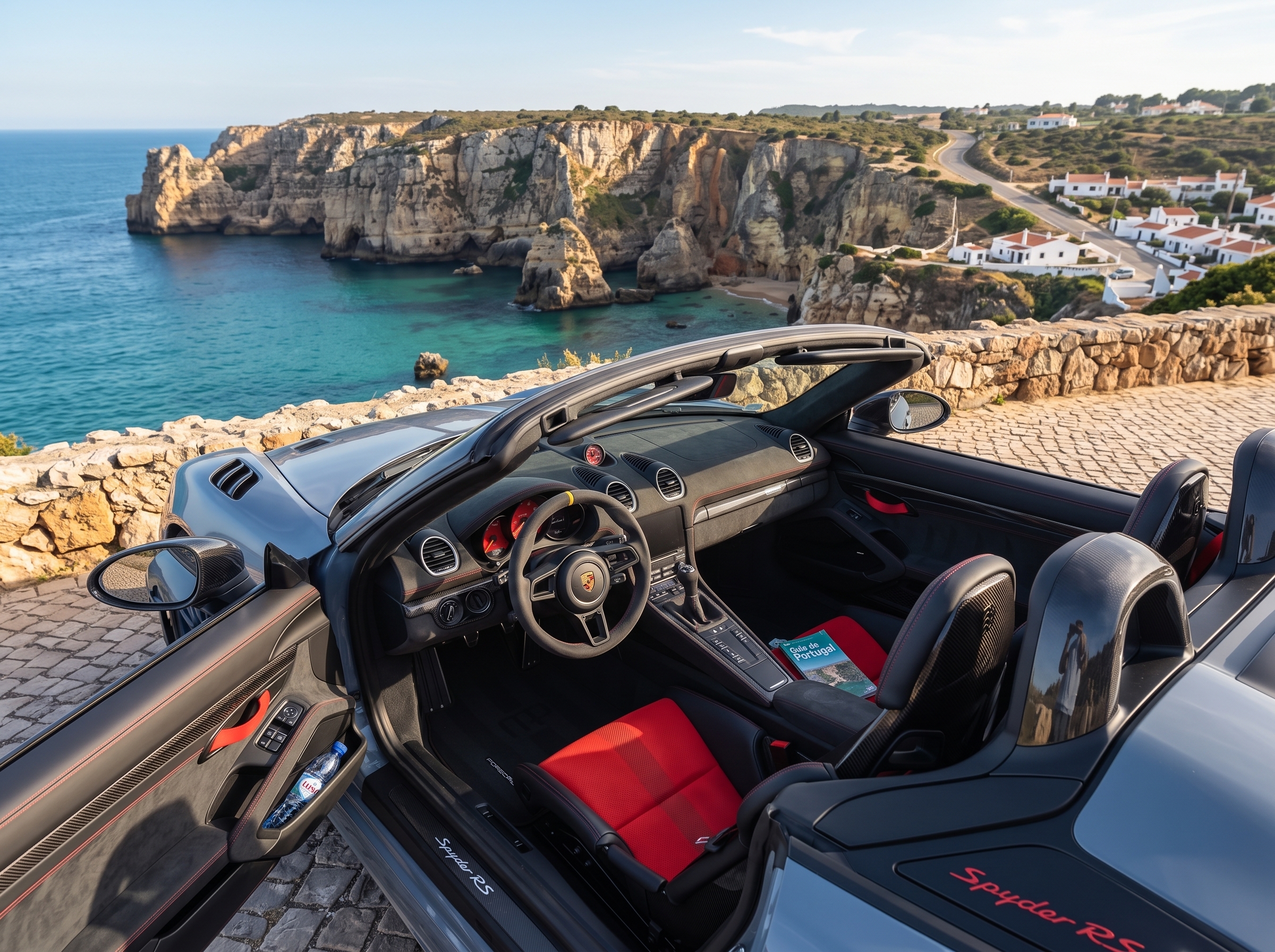
Lisbon begins at Belém, the smell of cinnamon and warm custard drifting from the bakery queues before you've even found the road. The Mercedes E-Class Cabriolet doesn't ask to be noticed the way some cars do, the roof folding itself away with a soft, mechanical certainty, the cabin settling into a hush that makes the cobblestones outside feel like someone else's problem.
Lunch means Cervejaria Ramiro, a multi-story seafood hall on Avenida Almirante Reis that's been feeding Lisbon since 1956 and feeding the rest of the world's curiosity since Anthony Bourdain sat down there on television. Scarlet shrimp first, then goose barnacles if you're willing to work for your food, then a whole spider crab if the table can handle it, and somehow, at the very end, a steak sandwich, because that's simply how a seafood meal finishes here.
Rua Augusta disappears under a canopy of lights come December, leading down to Praça do Comércio and a tree the whole riverfront square seems built around. Up at Eduardo VII Park, Wonderland Lisboa takes over the whole hillside, Portugal's largest Christmas market, a Ferris wheel turning slowly above an ice rink that has no business existing in a city this mild. Rossio runs its own smaller market a few blocks over, and Rua do Carmo strings its lights to music, timed well enough that strangers stop walking just to watch it happen twice. The Mercedes idles at the curb through all of it, leather still warm from the last hour of sun, in no hurry to be anywhere else.
The Estrada Marginal runs the whole way to Cascais along the water, the Tagus giving way to the open Atlantic partway through, and it's worth knowing what you're driving past. Estoril was the Portuguese Riviera once, the place dethroned European royalty washed up after the war, the future King Juan Carlos of Spain among them as a boy. Casino Estoril still stands where it always did, the largest in Europe, and it's the actual reason Ian Fleming wrote Casino Royale, having spent the war years there watching spies and exiled nobility play at the same tables. This is exactly the kind of road the E-Class was built to eat, long straights and easy curves, the six-cylinder settling into a low, contented murmur and staying there. Cascais itself keeps going a few kilometers further, all cliffside hotels and old money, the car looking entirely at home parked among it.
Explore Mercedes rentals in Lisbon
Naples is the city where a holiday calls for a Ferrari, not out of habit but because nowhere else does the marque feel quite this native. Via San Gregorio Armeno, the city's so-called Christmas Alley, is barely wide enough for the Ferrari F8 Spider's mirrors, workshop windows packed year-round with handmade terracotta figurines, traditional shepherds, and the odd satirical celebrity statue standing shoulder to shoulder with saints. Being somewhere that treats Christmas as a year-round trade makes the actual season feel like the one time it was always building toward. Lunch is Da Michele, over a hundred years old, two things on the menu, Margherita and Marinara, and no one's ever seriously argued they need a third. It doesn't matter what car you arrive in, everyone finds their way there by following the scent of the wood-fired oven. There's a reason Napoli-style pizza is sought after everywhere in the world; this is where it started.
San Gregorio Armeno runs its trade hardest right through this stretch of the calendar, the workshops staying open later, the crowds thicker, shepherds and angels crowding the windows alongside whichever politician or footballer earned a satirical figurine this year. The whole city strings up luminarie overhead, the kind of lights that turn an ordinary street into an occasion without anyone needing to say so.
Snow rarely touches Naples itself, but Vesuvius takes on a white cap most winters, visible from the city and from the coast road alike, the one reminder that this is still Italy even at its most Mediterranean. Skip the full run down the Amalfi Coast, the SS163 spends half the year under license-plate restrictions and traffic that turns an hour into an afternoon, and take the drive to Sorrento instead. The SS145 climbs out of Naples through terraced lemon groves, the ground itself changing under the tires as the volcanic plain gives way to limestone cliffs, Vesuvius holding its dusted summit in the mirrors the whole way. Sorrento waits at the end of it, Capri visible on a clear day, and the F8 finally gets a proper set of curves to work with, something the coast road further south never quite allows.
Evenings settle at Castel dell'Ovo, a medieval fortress built on its own small island and connected to the city by a single causeway. Legend has it a heartbroken siren named Parthenope washed ashore on these same rocks after failing to enchant Ulysses, and the Greek settlers who found her built the first version of this city in her honor. The castle's interior has been closed for restoration for years now, but nobody comes for the halls anyway. It's the walk out along the causeway that matters, fishing boats bobbing in the Borgo Marinari marina below, Vesuvius burning orange behind the silhouette of ancient stone as the sun goes down over water that's carried this story for two and a half thousand years. Parked near the seafront, the F8 sits quietly at home, built by the same Italian hands, centuries apart, that raised the walls behind it.
Explore Ferrari rentals in Naples
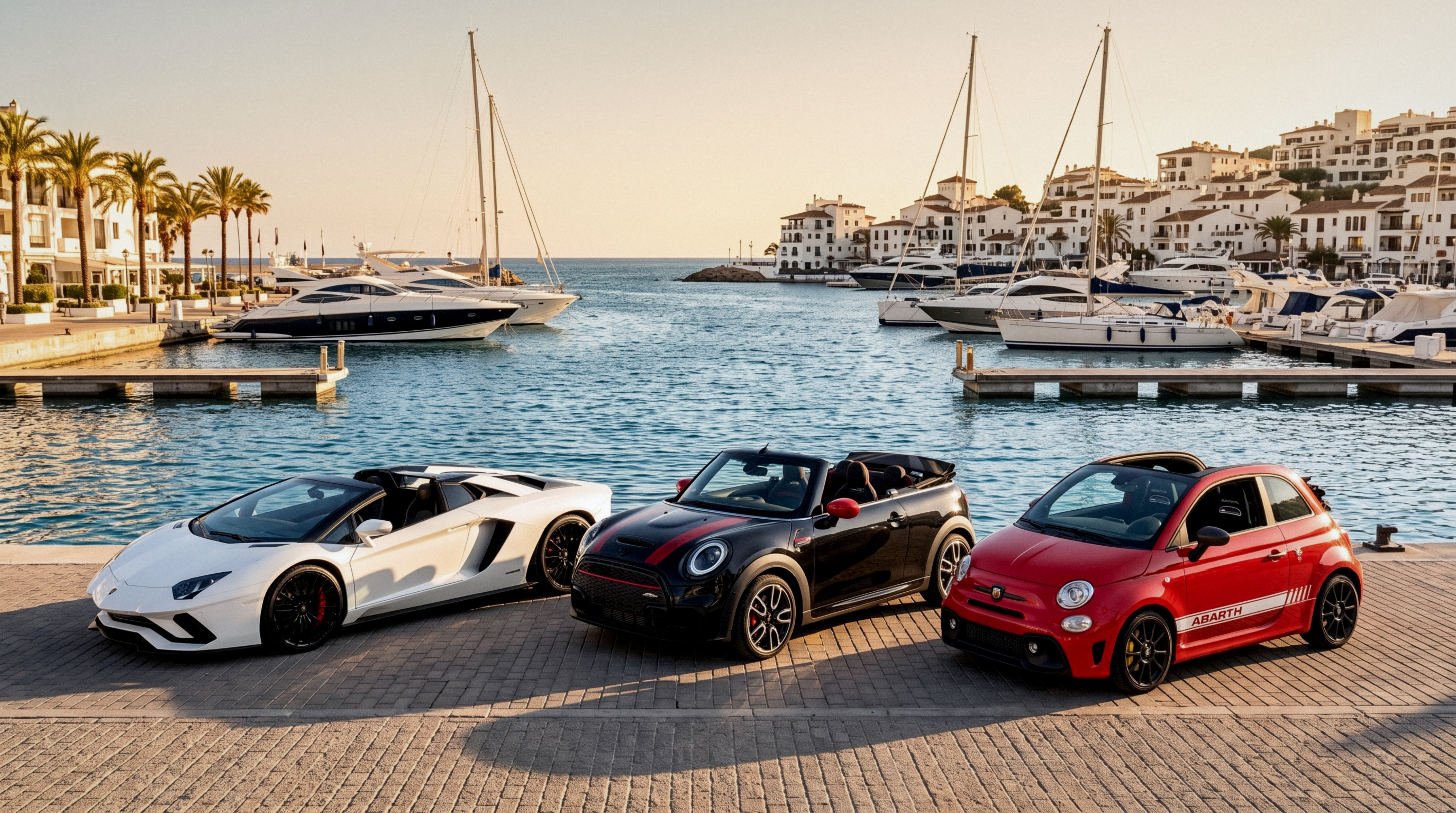
Every car on this page is a convertible, and that's not an accident. Good weather and a folding roof were made for each other, and the fleet carries more than 30 cars designed to be driven top-down. Grand touring at one end, pure open-air fun at the other, and plenty of ground covered in between.
Looking for a snowy escape? Our winter getaway guides map out the drives, markets and spa days for the Alps in Snow & Spa, and for Rome, Milan and Florence in Italian City Breaks.
A Porsche 911 Carrera S Cabriolet suits Málaga well, an open-top car for a coastal city with mild winters and warm spring afternoons.
A Lamborghini Huracán Spyder is a strong match for Barcelona, a city built around bold architecture and wide boulevards made for being seen on.
Granada is about ninety minutes from Málaga by car, with the Alhambra and the snow-capped Sierra Nevada visible from viewpoints in the city's Albaicín district.
Tarragona is under an hour and a half from Barcelona by car, home to a Roman amphitheatre and circus dating back roughly two thousand years.
An Audi R8 Spyder fits Alicante's mix of coastal boulevards and inland mountain roads, with the option to detour toward Guadalest for a genuinely twisty drive.
A Ferrari F8 Spider suits Naples more than anywhere else on this coast, an Italian car in the city where Ferrari feels most at home.
It's possible, but the SS163 is subject to license-plate driving restrictions for parts of the year and is often heavily congested with tour traffic. A drive to Sorrento along the SS145 offers similar coastal scenery without the same restrictions.
Yes. The fleet carries more than 30 convertible and open-top cars beyond the five named above, including the Aston Martin DB12 Volante, Ferrari 812 GTS, Lamborghini Aventador Roadster, Bentley Continental GTC, Jeep Wrangler, Abarth 695 Turismo, and Mini Cooper S in JCW trim.
Zeus Prestige is not affiliated with, sponsored by, or endorsed by any of the brands, venues, events, or public figures mentioned on this page. All names are referenced for descriptive purposes only.